Pages

Friday, 7 January 2011

Islamic State (2)

Presented in the previous post were a few salient features of an “Islamic state” as conceived by the founding fathers of Pakistan – especially Iqbal, Quaid-i-Azam and Liaquat Ali Khan. Looking at these features, we find that some of these overlap with secularism, some with theocracy and some with socialism.

This could be one of the three major reasons why the founding fathers’ vision was seldom understood by the intelligentsia. Already by 1947, the Muslim intelligentsia of the sub-continent had become sharply divided between secularist, conservative and socialist positions. Each of these groups saw only what it wanted to see in the statements of Iqbal and Quaid-i-Azam (and very often disregarding Liaquat Ali Khan altogether).

To say that the founding fathers of Pakistan wanted it to be a secular, theocratic or socialist state was equally wrong. Such a statement could only border on intellectual dishonesty. Secular Jinnah and Pakistan by Saleena Karim furnishes ample examples of such intellectual dishonesty – most famously committed by none less than a chief justice of Pakistan who attributed a “fake” quote to Quaid-i-Azam.

The Quaid may have foreseen this too. “Corruption is a curse in India and amongst Muslims, especially the so-called educated and intelligentsia,” he had written to his friend M. A. H. Ispahani in 1945. “Unfortunately, it is this class that is selfish and morally and intellectually corrupt.” (Quoted by Saleena Karim on p.133; emphasis is mine). This seems to be the second reason why the founding fathers’ concept of “Islamic State” got thrown into oblivion.

A third reason could be that this was a vision of the Islamic state as constantly developing through history – through “deed” of the masses rather than “ideas” of the elite. Grasping an ever-changing concept is a difficult thing, especially when it also requires us to be non-judgmental towards the less privileged.

This series of review will be concluded in the next post.

Monday, 3 January 2011

Islamic State (1)

Allama Iqbal, Qauid-i-Azam and Liaquat Ali Khan believed that the features of an Islamic state in modern times would include the following.

  1. SOVEREIGNTY: Sovereignty belongs to God, which means that the people as well as the state must treat the entire humanity as family and cannot adopt policies that refute this organic unity of the humankind.
  2. DEMOCRACY: Democracy is the most important aspect of Islam regarded as a political ideal, and therefore the state must be ruled by representatives chosen by the people.
  3. EQUALITY BEFORE LAW: Non-Muslims can also become executive heads (such as prime ministers) as long as they get themselves duly elected. However, the state may restrict the office of the ceremonial head (such as President without any real power) exclusively to Muslims.
  4. SOCIAL JUSTICE: Not only illegal means of acquiring wealth should be outlawed but also all forms of economic exploitation: the state must ensure economic equality through “Islamic socialism”.
  5. INNOVATION: Islamic state is constantly evolving through history, and it may take some other form in future (possibly where government is not needed anymore). However, the development can only be towards more empowerment of the people, and greater democracy, rather than the other way around.
Is this really Islam? Did Iqbal, Quaid and Liaquat Ali Khan actually believe this? If so, why didn’t we know? These are the most common questions that come up whenever I discuss these ideas.

Usually, I do not answer the first question. I believe that every Muslim has the right to interpret religion in their own way, and also has the right to consult a religious scholar out of free will. I am not a “religious scholar” as such, and my role as a historian ends on telling whether or not a certain idea was shared by some people in the past.

I know it as a historical fact that Iqbal, Quaid and Liaquat Ali Khan were unanimous on the above-mentioned concepts but whether they were right or wrong is not for me to judge.

The good news is that all three questions (and many, many, more) have been answered – elegantly and at length, with all the supporting evidence needed for the discussion – in Secular Jinnah and Pakistan: What the Nation Doesn’t Know by the distinguished researcher, Saleena Karim.

In the previous post I shared my observation that contrary to some other interesting studies about the Quaid, this one doesn’t make a painful reading for an average Pakistani. You may or may not agree with the author, but nowhere shall you feel as if she is unsympathetic to your religious sentiments, or trying to impose her views. Besides, the enormous amount of archival material presented here is valuable for its own sake. This includes excerpts from the writings, speeches and statements of the founding fathers; passages from parliamentary debates; arguments from Quran, and much else beside.

In the presence of this book, it shall become increasingly difficult for anyone to prove that the above-mentioned five points about an Islamic state were not shared by the founding fathers of Pakistan (just for record: the statements here are worded by me, but I hope that I was correct in inferring them from the book).

So, let’s move on to the last question: if this was the founding fathers’ idea of an Islamic state, why didn’t we know? This shall be discussed in the next post, but here is a hint: the answer is in the five statements themselves. Look again.

Friday, 31 December 2010

Secular Jinnah

Never judge a book by its cover, they say. Imagine a child who is interested in Yeti, comes upon a tantalizing title such as Yeti: the Abominable Snowman, and excitedly reads cover to cover only to find out that the book contains evidence to show that the abonimable snowman is a myth, and no such creature actually exists.

Remember this the next time you hear someone talk about Saleena Karim’s book, Secular Jinnah and Pakistan: What the Nation Doesn’t Know. Contrary to the title, the book is actually a well-researched and convincing study to show that “secular Jinnah” is a myth (and abonimable like the snowman: some readers might conclude)!

In my opinion, it is a book that must be read. I shall try to explain from a personal point of view why I think so.

The founder of Pakistan was the hero of those who wanted Pakistan, and therefore a villain to those who didn’t. The latter included the Western media, the Israel Lobby and Indian nationalists. Against the enormous influence of this school, the pro-Quaid point of view was bound to lose. It got buried by the early 1980s (the historical fiction, Gandhi, released on the big screen around that time, may also have contributed).

When it became too difficult to defend Pakistan and the Quaid at the same time, a new trend emerged among the pro-Quaid: never mind Pakistan, just defend Jinnah. The most well-known classics of this school include The Sole Spokesman (1984) by Ayesha Jalal; Jinnah of Pakistan (1984) by Stanley Wolpert; and the belated attempt by Jaswant Singh last year. In order to defend Jinnah internationally, some of these writers suggested that Jinnah didn’t actually want Pakistan.

Back in the 1980s, such writers were received like a breeze of fresh air. Compared to the homebred defenders of the Quaid, their work seemed to be presented with more elegance and better research. Hence, rasing the standards of research and widening the horizons was the permanent contribution of these writers, but there were drawbacks.

One of the drawbacks was the myth of “secular Jinnah”. Healthy debates are good for society, but unfortunately “some” secularists resorted to unfair means, such as a "fake" quote attributed to Jinnah by a former secularist Chief Justice of Pakistan – a "hoax" exposed by Saleena Karim in her previous work, and further explained here.

Coming out in the year 2010 – almost twenty years after Wolpert’s book got reprinted locally – Secular Jinnah and Pakistan brings things to full circle, in some ways. It gives back to the people of Pakistan their familiar Quaid-i-Azam: the father of the nation who shared their ideals and beliefs. He had been away for twenty years, but like the hero of Arthur Jones' play Silver King, he has come back more elegant and well-equipped than before. A must-read, and you may like to visit the book’s website too.

To be continued

Thursday, 30 December 2010

National anthem: fact and fiction

For some time now, some secularists in Pakistan have been suggesting that (a) Jinnah was in favor of secularism, and therefore (b) he commissioned a Hindu poet to write the national anthem of Pakistan but it was replaced by the present anthem after Jinnah’s death.

Therefore, it is rather serendipitous that two well-researched books should come out at the same time, each addressing a different half of this statement separately (and both having long titles, but that is beside the point):
  • Secular Jinnah and Pakistan: What the Nation Doesn’t Know by the British Pakistani writer Saleena Karim is a 317-page study about whether Quaid-i-Azam Jinnah wanted Pakistan to be a secular state.
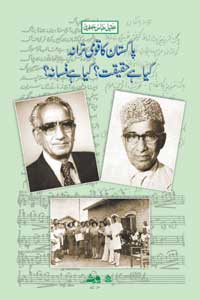
  • Pakistan Ka Qaumi Tarana: Kiya Hai Haqeeqat, Kya Hai Fasana by Aqeel Abbas Jafri is a 104-page analytical presentation of archival resources about the national anthem of Pakistan. 
The first book is in English, and the second is in Urdu, and let’s begin with the second. Although he is little known abroad, Jafri ‘s name has become synonymous with archival research in Pakistan. One of his most recent crowning achievements is the Urdu Chronicle of Pakistan, which presents a chronological illustrated history of the country since 1947.

In Qaumi Tarana (allow me to refer to the book by this short title), Jafri shows with conclusive documentary evidence that:
  1. Pakistan did not have a national anthem in the lifetime of Jinnah.
  2. The present national anthem was the first to be officially adopted by the state.
  3. There is no evidence to show that any poem by Jagan Nath Azad was played from radio on 14 or 15 August at all.
Some of the findings of this book were earlier shared by Jafri in his curtain-raiser article in Urdu press (covered here in a previous post, ‘Jafri reveals the truth’). The book offers much – much – more: a fantastic trip of time travelling to the early days of Pakistan, and inside the secret vaults of classified information, all in a light and refreshing manner.

I strongly recommend it to everybody. Being a basic document about a key symbol of our sovereignty, i.e. our national anthem, it should be kept in every household (Imagine losing your domicile certificate, passport, identity card and personal documents?). The book is modestly priced at Rs.200, which is roughly the same as a full plate of Biryani plus cold drink (and minus the TIP) – so, please do not “starve” your souls.

Now, very interestingly, while explaining that his purpose is just to keep the record straight, Jafri clarifies in the preface that it would not have been unexpected if the Quaid had actually got the national anthem written by a Hindu poet, but facts are facts and history needs to be respected. In the same vein he admits: “I do not have any doubts about Quaid-i-Azam Muhammad Ali Jinnah being secular, liberal and enlightened… Since Islam is the very name of tolerance.”

This brings us to the second book, which addresses the question: Did Quaid-i-Azam want Pakistan to be a secular state (and is secularism the same thing as the “tolerance” preached by Islam)? In the next post we shall see what Saleena Karim has to say about this in Secular Jinnah and Pakistan: What the Nation Doesn’t Know.
Next: Secular Jinnah

Wednesday, 29 December 2010

Secular Jinnah and the National Anthem

On the right you see the titles of two new publications that have just hit the stalls in Pakistan:
  • پاکستان کا قومی ترانہ از عقیل عباس جعفری
  • Secular Jinnah and Pakistan by Slaeena Karim
On the face value they may not seem to have anything in common, since one is just about the national anthem of Pakistan whereas the other seems to have a broader scope as it might be telling us all about Quaid-i-Azam’s vision of Pakistan. Personally, however, I see these two books as interconnected (but I am not suggesting in any way that the authors would also agree with this). This will be discussed in the next post.