Pages

Showing posts with label History. Show all posts

Tuesday, 13 December 2011

تانگے والے کا قائداعظم

آیے دیکھتے ہیں کہ قائداعظم کس طرح عوام کی بات جاننے کے لیے بیتاب رہتے تھے اور ماننے پر بھی آمادہ تھے [ایک پچھلی پوسٹ میں عرض کیا تھا کہ ہماری مشکلیں دو ہیں کہ ہم عوام کی بات جانتے بھی نہیں اور مانتے بھی نہیں]۔ مندرجہ ذیل تحریر قائداعظم کے سیکرٹری  مطلوب الحسن سید کی ہے۔ 

میسور کے نندی پہاڑ پر قائداعظم نے کچھ عرصے قیام کیا۔ وہاں ایک خط موصول ہوا۔ جو آگرے سے آیا تھا۔ خط اُردو میں تھا۔ اور لکھنے والے نے رُول دار کاغذ استعمال کیا تھا جو غالباً کسی رجسٹر سے پھاڑا گیا تھا۔ یہ خط ایک تانگے والے نے لکھا تھا۔ خط گالیوں سے شروع ہوا تھا لیکن بعد میں لکھنے والے نے لکھا تھا کہ ہماری گالیوں کا بُرا نہ مانیں کیونکہ ہم تانگے والوں کی زبان ہی ایسی ہوتی ہے۔ دراصل یہ ہمارے پیار کی زبان ہے۔ 

یہ خط دو قسطوں میں موصول ہوا تھا۔ پہلی قسط میں اس نے لکھا تھا کہ میرے پاس ایک سواری آ گئی ہے۔ اس لیے باقی خط پھر لکھوں گا۔ 

چنانچہ دوسری قسط دوسرے روز مل گئی۔ اس خط کا لبِ لباب یہ تھا کہ راقم الحروف کا سب سے بڑا شکوہ قائداعظم سے یہ تھا کہ قائد نے مسلمانوں کی قیادت کی دوسری سیڑھی کا تعین نہیں کیا۔ اُس نے لکھا تھا کہ قائداعظم تمہاری وفات کے بعد مسلمانوں میں ایک خلا پیدا ہو جائے گا جس کی وجہ سے مسلمانوں کو سیاست کے مخمصے میں پھنس جانے کا اندیشہ ہے۔ اس لیے اپنے نیچے کی قیادت کو ابھی سے منظم کرنا شروع کر دو۔ 

قائداعظم نے حسبِ دستور مجھے کہا کہ میں یہ خط پڑھ کر سناوں لیکن میں نے خط کو آغاز سے پڑھ کر سنانے سے انکار کر دیا۔ اور عرض کیا کہ اس میں گالیاں لکھی ہوئی ہیں۔ 

انہوں نے فرمایا کوئی بات نہیں اس کو پڑھو۔ جب میں نے نہ پڑھنے پر اِصرار کیا تو وہ بہت خفا ہوئے اور مجھے جھڑک کر کہا کہ تم کو پڑھنا پڑے گا۔ 

قائداعظم کے اس رویہ سے مجھے سخت صدمہ ہوا اور میں روہانسا ہو گیا۔ لیکن انہوں نے دوبارہ کہا کہ تمہیں خط پڑھنا ہو گا۔ اس پر میں نے عرض کیا کہ جس ماحول میں میری نشو و نما ہوئی ہے، اس نے میری زبان پر ایسی پابندی لگا دی ہے کہ ایسے الفاظ ادا کرنے کے لیے میری زبان کا پلٹنا مشکل ہے۔ 

اس پر وہ ذرا نرم ہوئے اور کہا کہ اچھا چھوڑ چھوڑ کر پڑھو۔ اس طرح وہ خط میں نے انہیں سنایا۔ لیکن جب میں اُس حصے پر پہنچا جہاں اُس نے قیادت کی دوسری سیڑھی کا ذکر کیا تھا تو اُنہوں نے کہا کہ دیکھو یہ خط معمولی نہیں ہے۔ اس تانگے والے نے بڑی دُوراندیشی کا ثبوت دیا ہے۔ اس خط کا اُسے جواب ضرور جانا چاہیے۔ 

لیکن تانگے والے نے اپنا خط کا پتا نہیں لکھا تھا۔ اس کا انہیں بیحد رنج ہوا۔ پھر مجھ سے کہا اس خط کا انگریزی میں ترجمہ کر کے مجھے دو۔

دو تین روز بعد انہوں نے اس خط کو پھر نکالا اور مجھ سے کہا کہ سیاست میں ٹھنڈے مزاج کی ضرورت ہے۔ سیاست میں رہ کر نہ تعریف کا اثر لینا چاہیے اور نہ گالیوں سے رنجیدہ ہونا چاہیے۔ ضرورت صرف اس بات کی ہے اپنا ضمیر صاف رکھو۔ انہوں نے کہا مجھے کیا حق پہنچتا ہے کہ مسلمانوں کی آیندہ قیادت کے لیے افراد کو منتخب کروں۔ مجھے یقین ہے کہ مسلمان اپنی قیادت کے لیے خود ہی کسی کو منتخب کر لیں گے۔ اور ایسا ہونا بھی چاہیے۔ مسلمانوں کی سیاست میری ملکیت تو نہیں ہے کہ میں اپنا جانشین مقرر کروں۔

ماخذ: قائداعظم میری نظر میں۔ مرتب زکریا ساجد، ناشر قائداعظم اکادمی کراچی۔ ص145سے 148  

Monday, 5 December 2011

امام حسین

علامہ اقبال نے 'رموزِ بیخودی' میں بتایا ہے کہ آنحضور صلی اللہ علیہ وسلم کی نبوت  کا مقاصد دنیا میں اُخوت، مساوات اور آزادی کا فروغ تھا۔ ان تینوں قدروں کے بارے میں اسلامی تصور کو علامہ نے ایک ایک تاریخی حکایت سے واضح کیا ہے۔ آزادی کے تصور کی وضاحت کے لیے کربلا کا واقعہ بیان کیا ہے۔ اس باب کا ترجمہ درجِ ذیل ہے۔ 

اِسلامی آزادی اور حادثہ ء کربلا کے راز کے بارے میں

جس کسی نے بھی ھُوَالمَوجُود کے ساتھ پیمان باندھا اُس کی گردن ہر معبود کے طوق سے آزاد ہو گئی۔
مومن عشق سے ہے اور عشق مومن سے ہے۔ ہمارا ناممکن عشق کے لیے ممکن ہے۔ 
عقل سفاک ہے اور عشق اُس سے بھی زیادہ سفاک ہے۔ زیادہ پاک، زیادہ چالاک اور زیادہ بیباک ہے۔
عقل اسباب اور وجوہات کے چکر میں پڑی ہوئی ہے ۔ عشق میدانِ عمل کا کھلاڑی ہے۔
عشق اپنے شکار کو زورِ بازو سے پکڑ لیتا ہے ۔ عقل مکار ہے اور جال پھینکتی ہے۔ 
عقل کا کام نااُمیدی اور شک سے نکلتا ہے۔ عشق کے لیے عزم اور یقین ناگزیر ہیں۔ 
وہ ویران کرنے کے لیے تعمیر کرتی ہے۔ یہ تعمیر کرنے کے لیے ویران کرتا ہے۔ 
عقل دنیا میں ہوا کی طرح عام ہے۔ عشق کمیاب اور مہنگا ہے۔
عقل کیسے اور کتنے کی بنیاد پر قائم ہے۔ عشق کے جسم پر کیسے اور کتنے کا لباس نہیں ٹھہرتا۔ 
عقل کہتی ہے اپنے آپ کو پیش کرو۔ عشق کہتا ہے اپنا امتحان لو۔
عقل اکتسابی ہے اس لیے غیر سے آشنا ہے۔ عشق خدا کی دین ہے اور اپنے آپ سے کام رکھتا ہے۔ 
 عقل کہتی ہے خوش رہو، آباد رہو۔ عشق کہتا کہ بندگی اختیار کرو تاکہ آزاد ہو جاو۔ 
عشق کی روح کا آرام آزادی میں ہے۔ آزادی اُس کی اونٹنی کی ساربان ہے۔

کیا تم نے سُنا کہ جنگ کے وقت عشق نے ہوس پیشہ عقل کے ساتھ کیا کیا؟
وہ عاشقوں کے امام، جنابِ بتولؓ کے لختِ جگر، رسول صلی اللہ علیہ وسلم کے باغ میں آزادی کا درخت-
اللہ کی شان دیکھو کہ باپ بسم اللہ کی ب اور بیٹا ذبحِ عظیم والی آیت کی تفسیر ہے
سب سے بہتر ملت کے اُس شہزادے کے لیے آخری نبی صلی اللہ علیہ وسلم کا کاندھا سواری کا نعم البدل بن گیا۔ 
غیرتمند عشق اُس کے لہو سے سرخ ہے۔ اُس کے مضمون سے اِس مصرع کی شوخی ہے۔
وہ عالی مرتبت ہستی اُمت میں ایسے ہے جیسے اُم الکتاب میں قل ھو اللہ احد!
موسیٰ اور فرعون، شبیر اور یزید دو قوتیں ہیں جو زندگی سے پیدا ہوتی ہیں۔ 
حق شبیر کی قوت سے زندہ ہے۔ باطل کا انجام ناکامی کی موت کا داغ ہے۔ 
جب خلافت نے قرآن سے رشتہ توڑ لیا تو آزادی کے منہ میں زہر ڈل گیا۔ 
تب خیرُ الاُمم کا وہ جلوہ آرا کعبہ کے بادل کی طرح اپنے دامن میں مینہ سمیٹ کر اُٹھا۔
کربلا کی زمین پر برسا اور گزر گیا۔ ویرانوں میں لالے کے پھول اُگائے اور گزر گیا۔ 
قیامت تک کے لیے استبداد کا خاتمہ کر گیا۔ اُس کے لہو کی موج نے باغ کھِلا دیا۔
حق کی خاطر خاک و خون میں لوٹ گیا اور یوں لا الٰہ کی بنیاد مضبوط کر دی۔ 
اگر آپؓ کا مدّعا سلطنت ہوتی تو آپ کبھی ایسے سازو سامان کے ساتھ سفر نہ کرتے،
آپؓ کے دشمن صحرا کی ریت کے ذروں کی طرح لاتعداد اور آپ کے ساتھی ”یزداں“ کے لفظ کے ہم عدد یعنی صرف بہتّر۔ 
آپؓ حضرت ابراہیم ؑ اور حضرت اسماعیلؑ کا راز تھے یعنی آپ اُس اجمال کی تفصیل تھے۔
آپؓ کا عزم کوہساروں کی طرح ڈٹا ہوا، ثابت قدم، چٹیل اور کامیاب تھا۔ 
تلوار صرف دین کی عزت کے لیے ہے ۔ اُس کا مقصد قانون کی حفاظت کے سوا کچھ اور نہیں۔
مسلمان اللہ کے سوا کسی کا غلام نہیں ہے۔ فرعون کے سامنے سر نہیں جھکاتا۔ 
آپؓ کے لہو نے اِس راز کی تفسیر بیان کر دی۔ سوئی ہوئی قوم کو بیدار کر دیا۔ 
جب آپؓ نے ”لا“ کی تلوار میان سے نکالی تو باطل کے سرپرستوں کی رگوں سے لہو کھینچ لیا۔
اِلا" کا نقش صحرا پر لکھ دیا۔ وہ ہماری آزادی کے عنوان کی سطر بن گئی۔" 
 ہم نے قرآن کے چُھپے ہوئے معنی حسینؓ سے سیکھے ہیں۔ آپؓ کی آگ سے شعلے اکٹھے کیے ہیں۔ 
شام کی شوکت اور بغداد کی شان رخصت ہو گئی۔ غرناطہ کی سطوت بھی یاد سے محو ہو گئی۔ 
تب بھی ہمارے ساز کے تار آج تک آپؓہی کے مضراب سے ہل رہے ہیں۔ آپ ہی کی تکبیر سے آج تک ہمارے ایمان تازہ ہیں۔ 
اے صبا! اے دُور پڑے ہوو ں کی قاصد! ہمارے آنسو لے جا کر اُن کی خاکِ پاک پر 
برسا دے۔


رموز بیخودی از علامہ اقبال۔ ترجمہ خرم علی شفیق 

Friday, 18 November 2011

اصلاح کیسے کریں؟

مجھے لگتا ہے کہ ہم سے پہلے کی نسل کے لوگوں میں بھی خامیاں تھیں مگر وہ انہوں نے دُور کر لیں۔ ہم کیسے کریں؟

یہ سوال مجھے کچھ عرصہ پہلے ایک نوجوان طالب علم کی طرف سے ایمیل میں موصول ہوا۔ اُردو بلاگ کی ابتدائی پوسٹس اِسی سوال کا جواب ہیں: تعلیم کا مقصد یہ ہونا چاہیے کہ ہمیں اپنے معاشرے کی باگ ڈور سنبھالنے کے قابل بنائے۔ اس کے لیے ضروری ہے کہ ہم اپنے معاشرے کے بارے میں جانتے ہوں اور معاشرے کی اجتماعی رائے پر عمل درآمد کروانے کے لیے تیار بھی ہوں۔ 

میں سمجھتا ہوں کہ میں جو کچھ بھی کہہ سکتا ہوں وہ اس مختصر سی بات میں آ جاتا ہے۔ باقی محض تشریح ہے، سو وہ بھی پیش کر رہا ہوں۔

اپنے معاشرے کے بارے میں جاننے کی چیزیں پانچ ہیں: تاریخ، ادب، سیاست، مذہب و سائنس اور تعلیم۔ 
  • تاریخ کا مطلب ہے کہ ہماری قوم نے اجتماعی طور پر کون کون سے اہداف مقرر کیے اور انہیں کس طرح حاصل کیا۔
  • ادب اُس چیز کا نام ہے جو ہمیں یہ بتاتی ہے کہ جو ہدف قوم نے اپنایا ہے اُس میں کون سے آئیڈیلز یعنی مقاصد چُھپے ہوئے ہیں۔
  • سیاست اُن آئیڈیلز کو عملی جامہ پہناتی ہے جو ہمارے ادب سے برآمد ہوتے ہیں۔
  • مذہب اور سائنس اُس حقیقت کے معانی سمجھاتے ہیں جو مندرجہ بالا عمل سے ہمارے اطراف میں وجود پاتی ہے۔
  • تعلیم ان معانی کو اگلی نسل تک پہنچانے کا نام ہے۔ 

اگر ہم اپنے معاشرے کے بارے میں یہ پانچ چیزیں جانتے ہوں تو ہم کہہ سکتے ہیں کہ ہم معاشرے کو جان گئے۔ ورنہ نہیں جانے۔  

Friday, 7 January 2011

Islamic State (2)

Presented in the previous post were a few salient features of an “Islamic state” as conceived by the founding fathers of Pakistan – especially Iqbal, Quaid-i-Azam and Liaquat Ali Khan. Looking at these features, we find that some of these overlap with secularism, some with theocracy and some with socialism.

This could be one of the three major reasons why the founding fathers’ vision was seldom understood by the intelligentsia. Already by 1947, the Muslim intelligentsia of the sub-continent had become sharply divided between secularist, conservative and socialist positions. Each of these groups saw only what it wanted to see in the statements of Iqbal and Quaid-i-Azam (and very often disregarding Liaquat Ali Khan altogether).

To say that the founding fathers of Pakistan wanted it to be a secular, theocratic or socialist state was equally wrong. Such a statement could only border on intellectual dishonesty. Secular Jinnah and Pakistan by Saleena Karim furnishes ample examples of such intellectual dishonesty – most famously committed by none less than a chief justice of Pakistan who attributed a “fake” quote to Quaid-i-Azam.

The Quaid may have foreseen this too. “Corruption is a curse in India and amongst Muslims, especially the so-called educated and intelligentsia,” he had written to his friend M. A. H. Ispahani in 1945. “Unfortunately, it is this class that is selfish and morally and intellectually corrupt.” (Quoted by Saleena Karim on p.133; emphasis is mine). This seems to be the second reason why the founding fathers’ concept of “Islamic State” got thrown into oblivion.

A third reason could be that this was a vision of the Islamic state as constantly developing through history – through “deed” of the masses rather than “ideas” of the elite. Grasping an ever-changing concept is a difficult thing, especially when it also requires us to be non-judgmental towards the less privileged.

This series of review will be concluded in the next post.

Monday, 3 January 2011

Islamic State (1)

Allama Iqbal, Qauid-i-Azam and Liaquat Ali Khan believed that the features of an Islamic state in modern times would include the following.

  1. SOVEREIGNTY: Sovereignty belongs to God, which means that the people as well as the state must treat the entire humanity as family and cannot adopt policies that refute this organic unity of the humankind.
  2. DEMOCRACY: Democracy is the most important aspect of Islam regarded as a political ideal, and therefore the state must be ruled by representatives chosen by the people.
  3. EQUALITY BEFORE LAW: Non-Muslims can also become executive heads (such as prime ministers) as long as they get themselves duly elected. However, the state may restrict the office of the ceremonial head (such as President without any real power) exclusively to Muslims.
  4. SOCIAL JUSTICE: Not only illegal means of acquiring wealth should be outlawed but also all forms of economic exploitation: the state must ensure economic equality through “Islamic socialism”.
  5. INNOVATION: Islamic state is constantly evolving through history, and it may take some other form in future (possibly where government is not needed anymore). However, the development can only be towards more empowerment of the people, and greater democracy, rather than the other way around.
Is this really Islam? Did Iqbal, Quaid and Liaquat Ali Khan actually believe this? If so, why didn’t we know? These are the most common questions that come up whenever I discuss these ideas.

Usually, I do not answer the first question. I believe that every Muslim has the right to interpret religion in their own way, and also has the right to consult a religious scholar out of free will. I am not a “religious scholar” as such, and my role as a historian ends on telling whether or not a certain idea was shared by some people in the past.

I know it as a historical fact that Iqbal, Quaid and Liaquat Ali Khan were unanimous on the above-mentioned concepts but whether they were right or wrong is not for me to judge.

The good news is that all three questions (and many, many, more) have been answered – elegantly and at length, with all the supporting evidence needed for the discussion – in Secular Jinnah and Pakistan: What the Nation Doesn’t Know by the distinguished researcher, Saleena Karim.

In the previous post I shared my observation that contrary to some other interesting studies about the Quaid, this one doesn’t make a painful reading for an average Pakistani. You may or may not agree with the author, but nowhere shall you feel as if she is unsympathetic to your religious sentiments, or trying to impose her views. Besides, the enormous amount of archival material presented here is valuable for its own sake. This includes excerpts from the writings, speeches and statements of the founding fathers; passages from parliamentary debates; arguments from Quran, and much else beside.

In the presence of this book, it shall become increasingly difficult for anyone to prove that the above-mentioned five points about an Islamic state were not shared by the founding fathers of Pakistan (just for record: the statements here are worded by me, but I hope that I was correct in inferring them from the book).

So, let’s move on to the last question: if this was the founding fathers’ idea of an Islamic state, why didn’t we know? This shall be discussed in the next post, but here is a hint: the answer is in the five statements themselves. Look again.

Friday, 31 December 2010

Secular Jinnah

Never judge a book by its cover, they say. Imagine a child who is interested in Yeti, comes upon a tantalizing title such as Yeti: the Abominable Snowman, and excitedly reads cover to cover only to find out that the book contains evidence to show that the abonimable snowman is a myth, and no such creature actually exists.

Remember this the next time you hear someone talk about Saleena Karim’s book, Secular Jinnah and Pakistan: What the Nation Doesn’t Know. Contrary to the title, the book is actually a well-researched and convincing study to show that “secular Jinnah” is a myth (and abonimable like the snowman: some readers might conclude)!

In my opinion, it is a book that must be read. I shall try to explain from a personal point of view why I think so.

The founder of Pakistan was the hero of those who wanted Pakistan, and therefore a villain to those who didn’t. The latter included the Western media, the Israel Lobby and Indian nationalists. Against the enormous influence of this school, the pro-Quaid point of view was bound to lose. It got buried by the early 1980s (the historical fiction, Gandhi, released on the big screen around that time, may also have contributed).

When it became too difficult to defend Pakistan and the Quaid at the same time, a new trend emerged among the pro-Quaid: never mind Pakistan, just defend Jinnah. The most well-known classics of this school include The Sole Spokesman (1984) by Ayesha Jalal; Jinnah of Pakistan (1984) by Stanley Wolpert; and the belated attempt by Jaswant Singh last year. In order to defend Jinnah internationally, some of these writers suggested that Jinnah didn’t actually want Pakistan.

Back in the 1980s, such writers were received like a breeze of fresh air. Compared to the homebred defenders of the Quaid, their work seemed to be presented with more elegance and better research. Hence, rasing the standards of research and widening the horizons was the permanent contribution of these writers, but there were drawbacks.

One of the drawbacks was the myth of “secular Jinnah”. Healthy debates are good for society, but unfortunately “some” secularists resorted to unfair means, such as a "fake" quote attributed to Jinnah by a former secularist Chief Justice of Pakistan – a "hoax" exposed by Saleena Karim in her previous work, and further explained here.

Coming out in the year 2010 – almost twenty years after Wolpert’s book got reprinted locally – Secular Jinnah and Pakistan brings things to full circle, in some ways. It gives back to the people of Pakistan their familiar Quaid-i-Azam: the father of the nation who shared their ideals and beliefs. He had been away for twenty years, but like the hero of Arthur Jones' play Silver King, he has come back more elegant and well-equipped than before. A must-read, and you may like to visit the book’s website too.

To be continued

Thursday, 30 December 2010

National anthem: fact and fiction

For some time now, some secularists in Pakistan have been suggesting that (a) Jinnah was in favor of secularism, and therefore (b) he commissioned a Hindu poet to write the national anthem of Pakistan but it was replaced by the present anthem after Jinnah’s death.

Therefore, it is rather serendipitous that two well-researched books should come out at the same time, each addressing a different half of this statement separately (and both having long titles, but that is beside the point):
  • Secular Jinnah and Pakistan: What the Nation Doesn’t Know by the British Pakistani writer Saleena Karim is a 317-page study about whether Quaid-i-Azam Jinnah wanted Pakistan to be a secular state.
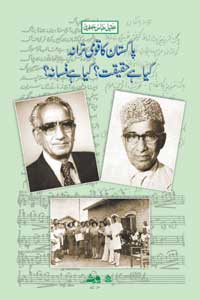
  • Pakistan Ka Qaumi Tarana: Kiya Hai Haqeeqat, Kya Hai Fasana by Aqeel Abbas Jafri is a 104-page analytical presentation of archival resources about the national anthem of Pakistan. 
The first book is in English, and the second is in Urdu, and let’s begin with the second. Although he is little known abroad, Jafri ‘s name has become synonymous with archival research in Pakistan. One of his most recent crowning achievements is the Urdu Chronicle of Pakistan, which presents a chronological illustrated history of the country since 1947.

In Qaumi Tarana (allow me to refer to the book by this short title), Jafri shows with conclusive documentary evidence that:
  1. Pakistan did not have a national anthem in the lifetime of Jinnah.
  2. The present national anthem was the first to be officially adopted by the state.
  3. There is no evidence to show that any poem by Jagan Nath Azad was played from radio on 14 or 15 August at all.
Some of the findings of this book were earlier shared by Jafri in his curtain-raiser article in Urdu press (covered here in a previous post, ‘Jafri reveals the truth). The book offers much – much – more: a fantastic trip of time travelling to the early days of Pakistan, and inside the secret vaults of classified information, all in a light and refreshing manner.

I strongly recommend it to everybody. Being a basic document about a key symbol of our sovereignty, i.e. our national anthem, it should be kept in every household (Imagine losing your domicile certificate, passport, identity card and personal documents?). The book is modestly priced at Rs.200, which is roughly the same as a full plate of Biryani plus cold drink (and minus the TIP) – so, please do not “starve” your souls.

Now, very interestingly, while explaining that his purpose is just to keep the record straight, Jafri clarifies in the preface that it would not have been unexpected if the Quaid had actually got the national anthem written by a Hindu poet, but facts are facts and history needs to be respected. In the same vein he admits: “I do not have any doubts about Quaid-i-Azam Muhammad Ali Jinnah being secular, liberal and enlightened… Since Islam is the very name of tolerance.”

This brings us to the second book, which addresses the question: Did Quaid-i-Azam want Pakistan to be a secular state (and is secularism the same thing as the “tolerance” preached by Islam)? In the next post we shall see what Saleena Karim has to say about this in Secular Jinnah and Pakistan: What the Nation Doesn’t Know.
Next: Secular Jinnah

Saturday, 25 December 2010

Learn from experience

2006: Female cadets at the Quaid's tomb
The following is my article published as Friday Feature in Dawn on December 24, 2010. Some of the wording may vary from the printed version.
The year 1987 was memorable because even those segments of the population who had not been much interested in politics during the various struggles for the restoration of democracy earlier in the decade were now feeling restless. This presumption was corroborated by the historic turnout during the elections that followed a year later. The elections of 1988 were the second occasion in the history of Pakistan where the results, however rigged they may have been, were at least accepted by all major contestants (the first such occasion were the elections of 1970).

In the light of the ideals indigenously developed since 1887, and the goals achieved through them, there are reasons to believe that the new goal that had appeared before the nation in 1988 was actually “emancipation” rather than anything else. This goal had to be achieved through the “inner synthesis” of diverse political experiments carried out in the previous twenty years. The ideal of to be pursued whilst in quest of the goal was “Learn through experience.”

Emancipation was the new goal. This may be concluded from the fact that according to the generally accepted views, conventional democracy (i.e. Western democracy) pre-requires a high literacy rate, which did not exist in Pakistan at that time (nor does it now). If so, then the masses had less reason to care for such democracy and more to care for the other, indigenous, variety that had already been idealized by them: it had been taught to them by the most influential teachers, preachers, poets and artists for more than a thousand years. It was the spiritual democracy, envisioned by the more genuine schools of Sufism in the past, and more recently turned into a political idea by the likes of Shah Abdul Latif Bhittai, Shah Waliullah, Waris Shah, Sir Syed Ahmad Khan, Ali Brothers and Allama Iqbal. (For a detailed outline of this development, see the previous articles by the present writer published in this newspaper).

In The Reconstruction of Religious Thought in Islam (1930-34), Iqbal stated that for a Muslim, this idea was “a matter of convic¬tion for which even the least enlightened man among us can easily lay down his life.” Hence, the indigenous conception of democracy does not pre-require literacy or formal education, but only spiritual emancipation. Does it not seem natural that the true aspiration of the masses can only be this indigenous variety of democracy? It does not degrade them because of poor literacy rate. It has been ingrained into their consciousness by the best-loved poets and teachers in more than a thousand years.

Just as conventional democracy pre-requires literacy and education, the indigenous variety calls for spiritual emancipation (in the above-mentioned passage, Iqbal goes on to say, “in view of the basic idea of Islam that there can be no further revelation binding on man, we ought to be spiritually one of the most emancipated peoples on earth”).

Spiritual emancipation, in this sense, means emancipation in all spheres of life rather than just one. Artistic and literary, social and political, religious and legal, education and psychological emancipations collectively amount to spiritual emancipation.

In retrospect, we may recognize that we started pursuing this goal in 1987. Unlike some of the earlier goals, such as Muslim nationhood, separate electorates and Muslim homeland, the goal was not clearly stated on this occasion. Beginning with the election of a woman prime minister ahead of any other Muslim nation, the journey towards emancipation was carried out, perhaps, unknowingly for the most part. The quarrels between Benazir Bhutto and Nawaz Sharif, the work of the human rights activists and the feminists, the so-called enlightened moderation at the turn of the millennium, the emergence of an all-powerful media with its good and bad influences, and the uneasy alliances with the Western powers may all have contributed towards the achieving of our goal. The strongest factor, however, was undoubtedly the “inner synthesis” of the diverse political ideologies that had been tried out since 1967.

In the absence of a well-stated ideal, the only ideal to be pursued was to learn from experience. This was also important because the emancipation that we were trying to achieve was unprecedented. It was a long-cherished goal that had never become a reality for our society during the long centuries of tyrants and despots. Therefore, the best way forward was to learn from experience.

The benchmark came in 2006, when judicial activism of the Chief Justice of Pakistan, Iftikhar Chaudhry, prevailed upon the combined whim of a native military ruler and the sole super power on earth, and made them answerable in a court of law for “the missing persons”, most of whom were not only insignificant citizens, but also disfavored citizens.

As if to symbolize the ethos of the past twenty years, six women cadets and a Sikh gentleman cadet were seen among the contingent that took over guard duties on the mausoleum of the Quaid-i-Azam on 25 December 2006. The 130th birth anniversary of the founder of Pakistan was indeed a good day to mark the end of a stage in the history of the nation, and to start preparation of the next stage. “Emancipation”, which was the goal achieved in the past twenty years, was soon going to become a tool for achieving the next goal, and a new ideal would then be pursued.

Friday, 26 November 2010

Unite Organically

The following is my article, which appeared as Friday Feature, 'On Organic Unity' in Dawn today. The text presented here may vary from the version printed in the newspaper.
A new goal that appeared before the people of Pakistan in 1967 was to discover a synthesis of socialism and democracy through Islam. The tool for achieving it was the organic unity that Pakistan had achieved in its first twenty years as a new state. The ideal to be kept in front was to use this unity, i.e. unite organically, or through ideals. Some indicators may show us that a synthesis had occurred, in some ways, by 1986.

This may sound like a far-fetched hypothesis because we are not used to reading the history of modern Muslim thought in this manner. However, such a conclusion seems to be the only plausible one when the matter is revisited in the light of the propositions of Sir Syed Ahmad Khan, Muhammad Ali Jauhar, Allama Iqbal and Quaid-i-Azam.

For that, we may begin with three essential concepts: (a) synthesis of ideologies through Islam; (b) organic unity as a human resource; and (c) definition of ideals.

When Pakistan People’s Party (PPP) was founded on 30 November and 1 December 1967, its credo was stated to be, “Islam is our religion; democracy is our politics; socialism is our economy; power lies with the people.” The intellectuals who wrote the foundational papers of the party, as well as Zulfikar Ali Bhutto who founded the party, may or may not have been aware, but the ideas mentioned in this credo had a long history in the collective consciousness of the society. As it was, Maulana Shibli Numani and Allama Iqbal had stated democracy to be the political ideal of Islam long ago, Quaid-i-Azam had talked about Islamic socialism and the very idea of Pakistan was based on the presumption that all power lied with the people.

Hence, the enormous popularity of this credo, as evident from the results of the elections of 1970 in West Pakistan, need not have meant that the people were willing to embrace a new ideology. They had not said yes to socialism, but to its synthesis with democracy and Islam (on the condition that all power remains with the people). Such a synthesis would not have been unprecedented in the history of Islam, since a primary function of Islam had always remained to be the assimilation of alien ideas and beliefs, and their re-evaluation for practical uses in Muslim cultures.

There was no reason to believe that Islam would not do the same for modern ideas and beliefs, such as Western democracy and socialism (in fact, as early as 1920, Iqbal had forewarned the Orientalist R. A. Nicholson, “Islam certainly aims at absorption. This absorption, however, is to be achieved not by territorial conquest but by the simplicity of its teaching, its appeal to the common sense of mankind and its aversion to abstruse metaphysical dogma.”)

The synthesis of ideologies had to occur in the consciences of the individuals. Indeed, that is what happened between 1967 and 1986, but it seems that the intelligentsia failed to notice it due to a “predominantly intellectual culture” (loathed by Iqbal as early as 1926). Hence, the synthesis that occurred was, in the terminology of Iqbal, “an inner synthesis of life”, but unfortunately, it has not been articulated by the intelligentsia to this date.

Mainly due to this failure on part of the intelligentsia, the process of synthesis became tedious, painful and unconscious. First, the country had to withstand the harsh socialistic measures taken by Zulfikar Ali Bhutto during his first tenure, i.e. 1971-77. Then a certain kind of Islamization was introduced by General Ziaul Haque during his regime, i.e. 1977-1987. Just a year before the end of that regime, it became obvious that all schools of thought, now also including the right-winged conservatives who had earlier played as “B-Team of the Martial Law”, had come to an agreement for a full-scale adoption of Western democracy without any indigenous modification whatsoever.

This brings us to the second concept, i.e. organic unity as a human resource. Organic unity means unity through shared ideals. Obviously, the conscience of the people must have retained something from each experiences through which the society passed collectively. While the intelligentsia failed to synthesize socialism, Islam and democracy, the masses evidently synthesized these diverse experiences at least at an unconscious level. Therefore, the synthesis has to be sought at the level of ideals, even if not in terms of day-to-day reality. In this sense, ideals are those aspirations that form in the depth of our hearts or souls. They are formed through action, and as an aid to action.

Once formed, ideals express themselves in their own way. This may also explain why the histories of Bangladesh and Pakistan, even after their separation in 1971, reveal some striking similarities. It is quite possible that despite being completely independent of each other, as self-respecting sovereign states must be, both have retained some common ideals from their common past – especially when they struggled to shape Muslim nationalism in South Asia.

Thursday, 4 November 2010

Respect the Law

The following is my article published in Dawn on October 29, 2010, as Friday Feature, 'Respecting the Law'. Some of the wording might be slightly different from the printed version.
With the birth of Pakistan, the Muslim community of the sub-continent not only created a new country but also a new nation. The first goal of this nation was to achieve a kind of organic unity, and Pakistan itself was the tool for achieving it. Respecting the law was the ideal to be kept in front. Studying the history of Pakistan in this light, one finds many indicators suggesting that the goal was achieved by 1966.

Obviously, this requires us to understand three concepts first. They are (a) organic unity; (b) Pakistan as a tool for achieving it; and (c) the significance of respecting the law in this special context.

The organic unity intended here is based on a portion of Verse 28 of Surah Luqman (Chapter 31 of the Quran). It is translated by Iqbal as, “Your creation and resurrection are like the creation and resurrection of a single soul.” Creation and resurrection are biological concepts, and hence the kind of unity implied in this verse is a biological unity, as if entire humanity was a single organism and individuals were its parts. If such a connection exists between all human beings, then obviously it is moderating the worldly and spiritual power of each individual, whether he or she knows it or not.

Giving us awareness of this connection is the aim of religious thought, according to Iqbal. However, thought alone cannot be sufficient. We need a practical tool as well. Hence, in the preface of The Reconstruction of Religious Thought in Islam (1930), Iqbal wrote, “A living experience of the kind of biological unity, embodied in this verse, requires today a method physiologically less violent [than the methods devised by the past masters] and psychologically more suitable to a concrete type of mind.”

The same year, while presiding over the annual session of the All-India Muslim League at Allahabad, he seemed to be suggesting that the achievement of a Muslim homeland in the region could become, somehow, the new method through which this kind of organic unity would be realized. In his presidential address, after proposing and predicting the birth of a Muslim homeland, he went on to suggest, “One of the profoundest verses in the Holy Quran teaches us that the birth and rebirth of the whole of humanity is like the birth and rebirth of a single individual. Why cannot you who, as a people, can well claim to be the first practical exponent of this superb conception of humanity, live and move and have your being as a single individual?”

Hence, if we could “live and move and have [our] being as a single individual,” we would experience what is meant by the Quran when it says that the creation and resurrection of the humanity is like the creation and resurrection of a single soul (and it seems that neither Iqbal nor Jinnah meant to exclude the non-Muslim citizens of the Muslim homeland, since according to the Quran, this organic unity is a biological fact that moderates the existence of every individual on this planet).

If Pakistan was the tool – “a method psychologically suitable to a concrete type of mind” – for discovering this organic unity, how was this tool going to be used? The most logical answer was, by respecting the law. This was how the homeland had been achieved in the first place, and even against the bitter opposition by powerful and unfair adversaries.

The first twenty years of Pakistan present a curious case study when visited in the light of this ideal. It seems as if the educated elite and the intelligentsia were on one side, often ignoring the significance of the ideal and the implications of the recent history. Apparently, due to the one hundred and fifty years of British domination, much power had been left in the hands of the liberals and those who favored secularism in some form. Quite often they were found to be guilty of abusing that power, for instance when Chief Justice Muhammad Munir, a self-proclaimed believer in secularism, upheld the decision of Governor-General Ghulam Muhammad to abrogate the elected parliament. Conservatives and socialists, perceiving that the just demands of the people were being suppressed, would often invite the masses to agitation and direct action. When the masses chose to ignore such calls, they were accused of lacking in political awareness.

Hence, the unschooled masses of Pakistan seem to be standing on the other side, clearly distinguishable from the reactionary educated elite and the intelligentsia. At least three successive events in the last three years of this period should have vindicated the masses against the widespread accusation of being politically unaware. These were the tremendous unity displayed in supporting Fatima Jinnah against Field Marshall Ayub Khan in the presidential election of 1964, the display of patriotism during the 1965 War and the general outcry against Ayub Khan after the signing of the treaty at Tashkent in 1966.

These are some indicators in terms of the broader current of history only. Understanding and experiencing their deeper meaning requires us to revisit our literature, politics and religious thought with a new approach, which has never been attempted (and unfortunately, our education offers us little preparation for such a task). However, in terms of the general outline of the story of our ideals as a Muslim nation, the year 1966 seemed to be the moment when the ambiance of being a ‘new country’ had ended, and the nation seemed poised for starting a new stage, together.

Saturday, 30 October 2010

Rise Above Yourself

The following is my article published in Dawn on October 15, 2010, as Friday Feature, 'For a common destiny'. Some of the wording might be slightly different from the printed version.
The election of 1926 was the first occasion when Muslim masses voted in large numbers according to separate electorate. However, in the assemblies that were inaugurated the next year as a result of this election, no single party had emerged as common leader of the entire Muslim community. It seemed as if there was no new ideal, no commonly agreed goal anymore, and hence no means for a collective effort.

This, however, did not last very long. In 1928, Congress demanded through Nehru Report that separate electorates should be abolished. Apparently, it was impossible for an Indian nationalist to understand what a separate electorate meant to a Muslim.

Unity of matter and spirit as a philosophical concept may be incomprehensible by ordinary persons but the activities of the Aligarh Movement and its offshoots in the past sixty years had been sufficient for showing even the most unschooled Muslim how literature, politics, religion and education were interconnected as far as the Muslim community of the region was concerned. Separate electorate appeared to be a tool for formalizing this unity of ideals and reality. Hence when Nehru Report questioned the separate electorates in 1928, Muslim leaders who disagreed on everything else suddenly agreed to disagree with the Hindu majority on this issue.

Against this backdrop, Allama Iqbal, who was also a successful candidate of the election of 1926, presided over the annual session of the All-India Muslim League held in Allahabad on December 30-31, 1930. There, he proposed a new goal. It was “a consolidated North-West Indian Muslim state”, which appeared to him to be “the final destiny of the Muslims at least of the North-West India.”

Thus, Pakistan became the next goal to be achieved (and Iqbal left open the possibility of it being “within the British Empire, or without the British Empire”). Separate electorates then became the tool through which the new goal, Pakistan, was to be achieved.

The ideal to be pursued whilst in quest for Pakistan was “selflessness”, which Iqbal had been preaching at least since 1906. It was embodied in verses that had become proverbial to at least two successive generations, such as the famous line from a 1912 poem, “An individual is sustained by its bonding with the nation and is nothing on one’s own, just as the wave exists in the river and is nothing on its own.”
فرد قائم ربط ملت سے ہے تنہا کچھ نہیں
موج ہے دریا میں اور بیرون دریا کچھ نہیں
As explained in his longer poems and his lectures, selflessness (or bekhudi) was an experience through which an individual could annihilate his or her individual ego (khudi) and arrive at the next level, which was the collective ego, thus acquiring a greater wisdom inaccessible to the individual ego alone.

Iqbal’s conception of a collective ego did not mean that one should cease to have personal opinions, or renounce the freedom of thought and expression. Selflessness was not an act of the mind but an act of love, through the heart. It could only be induced through highly entertaining literature (as Iqbal did in his own times) and could never be imposed through repressive legislation (in fact the suppression of individual liberties could become a hindrance, since it curtails selflessness by enhancing mistrust).

This emphasis on transcending the individual ego was timely, since the elections of 1926 had presented a highly egotistical picture of the community. “Things in India are not what they appear to be,” he said in the Allahabad Address. “The meaning of this, however, will dawn upon you only when you have achieved a real collective ego to look at them.”

Selflessness, or rising above oneself, became the new ideal as the demand for Pakistan gained momentum under the leadership of Jinnah, “the Great Leader”, whom his followers came to see as the incarnation of their ideal in flesh and blood. How the new state came into being is a story that belongs to political history. What ought to be noted here is that the goal was achieved through the election of 1945-46 when an overwhelming majority of Muslims voted for Pakistan, especially in provinces where they were in a minority and were not going to be included in the proposed state.

Pakistan could not have come into being without their support but voting for Pakistan meant invoking the almost inevitable wrath of the future rulers of India. They voted, and they paid the price with their blood and tears. Recorded history of the human race may not offer another instance when such a large number of people made a common decision that required such high degree of selflessness.

Iqbal had said in the Allahabad Address, “Rise above sectional interests and private ambitions, and learn to determine the value of your individual and collective action, however directed on material ends, in the light of the ideal which you are supposed to represent.” The Muslim masses of India could not have followed his words more diligently.

Friday, 1 October 2010

Think Long-Term

The following is a revised version of my article published as Friday Feature in Dawn today.
The birth of All-India Muslim League on December 31, 1906 in Dacca was the biggest consensus ever achieved in the history of Islam. It brought together diverse sects of Muslims under one banner. Twenty years earlier, Muslims of the sub-continent had set their goal to become “a real nation” rather than “a nation only in name”, and that goal was now achieved. Hence the stage that had started in the modern history of the community in 1887 came to an end.

The League offered a new goal. It was to win separate electorate for Muslims in the sub-continent. Since they were a minority in the region, their newly realized nationhood could only be preserved if they were represented as an organic unity in the legislatures (the idea had been originally presented by Syed Mahmood, son of Sir Syed Ahmad Khan, in 1896).

This became the explicitly stated goal of the League, which described itself as the means through which this goal was going to be achieved. Hence a second stage could be said to have started in 1907 and completed in 1926 when separate electorates were effectively achieved and exercised (as described below in more detail).

However, it may be helpful to remember that membership of assemblies at that time was through nomination. General elections had not yet been introduced in the sub-continent (and were not conceded until 1919). Hence separate electorate was not something that concerned a citizen in daily life. If still the ordinary people became interested in it then obviously they were thinking long-term.

Hence pursuing separate electorate also meant embracing a new ideal, “Think Long-Term”. This did not mean that all details ought to be laid out in advance, since the future generations were likely to discover new ideals of their own. Therefore, commitment should not be to any particular ideology but to the society itself. A generation should pick a goal that everybody considers most important for conserving the common ideals. Things should be readjusted according to this goal but it should be remembered that tomorrow would be another day: the future always exists as an open possibility.

This approach can be best illustrated through a statement of Muhammad Ali Jauhar about the birth of the League itself. Jauhar said (ironically while presiding over an annual session of the Congress) that the birth of the League was a result of the MAO College founded at Aligarh nearly thirty years earlier in 1877 (“In obedience, as it were, to a law of nature,” he said. “Once more after nearly thirty years after the foundation of the College, there came into being a political institution of the Muslims.”)

Interestingly, the founder of the Aligarh College, Sir Syed Ahmad Khan, had advised his followers to stay away from politics. Yet, his arch-disciple Jauhar not only named him as the major catalyst for the birth of a political party but also regarded him as the pioneer of Muslim political activity in the sub-continent.

This is often very difficult to be understood by scholars steeped in the Western academic paradigm but from the perspective of “long-term thinking” as practiced by Syed and Jauhar, our real identity is not defined by our specific opinions. It consists of our ideals, goals and the means we leave behind for achieving goals. Superficially, Jauhar and his colleagues seemed to be the antithesis of Syed but in terms of ideals and goals they were continuing the initiative started by him. Hence Jauhar addressed him ecstatically in a famous poem, “You are the one who taught us all this rubble-rousing. If we are the height of it, you were its genesis.” (Sikhaya thha tumhi nay hum ko yeh shore-o-shaghab sara/ Jo is ki inteha hum hain toe is ki ibtida tum ho).

It seems that the demand for separate electorate fired the imagination of the common people in such a manner that the ideal, “Think Long-Term” sunk into the hearts too. Tendency of seeing beyond immediate environment seemed to increase as the demand for separate electorate gained momentum. This could be judged from the way the community responded to the affairs of far-off places like Balkan, Tripoli and Gallipoli. After their Hindu compatriots conceded separate electorate by signing the Lucknow Pact in 1916, Muslims of the sub-continent went to the extent of joining them in the Non-Cooperation Movement of the early 1920s. They even went ahead to boycott Election 1922 on behest of Indian nationalists, although direct voting had been introduced for the first time on that occasion and the voting was to be done through separate electorate.

Think long-term, because you are part of a bigger picture, which is alive and breathing. This much was understood instinctively by a Muslim – especially the unschooled one, whose consciousness was less tainted by foreign education.

It was an ideal that could be epitomized and conveyed, not less effectively than the poetry of Allama Iqbal and the heart-to-heart journalism of Muhammad Ali Jauhar and Zafar Ali Khan, by even a balled written by a little-known poet and sung in the streets in the days of Khilafat Movement, “Bolien Amman Muhammad Ali ki/ Jaan beta khilafat pay day doe” (“Said the Mother of Muhammad Ali: O Son, lay down your life for the Caliphate”). Think long-term because you are part of a bigger picture.

By pursuing the ideal of long-term thinking, the community finally achieved its stated goal. Election 1926 witnessed a historic turnout. Non-Cooperation Movement was long over. Masses thronged to polling stations and cast their votes through separate electorates. The League had served its purpose. It was time to discover the next ideal and set a new goal.

Friday, 17 September 2010

Seek Consensus

The following is my article published as "Friday Feature" in Dawn, September 17, 2010.
THEY were 67, and represented the largest Muslim community in any one country. They had come to Aligarh from all over British India, and included knights and nawabs as well as primary school teachers and ordinary people.

Since 150 chairs were laid out in the Stretchy Hall of Mohammedan Anglo-Oriental College, some 70 students also got invited for filling the vacant seats. The issue, in the words of their host, Sir Syed Ahmad Khan, was this: “Although we are called a nation, we are unaware of each other’s circumstances, as if we were different peoples.”

The participants wanted to realise a Muslim nationhood. To this end they agreed to hold annual gatherings where the community could reach consensus on matters of national importance. The organisation holding these sessions, each year in a different city, was to be called Mohammedan Educational Congress (later changed to Conference). It came into being on December 27, 1886.

This event may qualify as the starting point for the present phase in the history of the development of Muslim thought in the subcontinent. Although the idea of consensus was rooted in the Quranic instruction that believers should consult each other when deciding important matters, no Muslim community after 7th century CE had been able to make its own consensus the final arbiter, since monarchs had come to hold sway after the Pious Caliphate of the early period. Hence the resolution of 1886 was the beginning of a new chapter, not only in India but across the world of Islam. It read:
"In view of an overall decline in education among Muslims, and with a mind that efforts should be made for progress in all forms of education through a national consensus and by taking national initiatives, it is desirable that a session called Mohammedan Educational Congress, comprising people from several districts, should be held every year for deliberating on such matters. This session shall not be held at a fixed place but held each year at a place whose residents are willing to make arrangements for it.”
The rationale behind founding such an organisation was, in the words of Sir Syed, “that we should meet and convey to each other our ideas regarding education and progress of the nation. Whatever mistake there might be in our thinking should get corrected through the opinions of others.”

Hence the idea of rejuvenating Muslim thought in regard to education, a Quranic injunction no less than one that urged the faithful to consult amongst themselves on matters of public good, was different from ‘consensus’ as viewed in a western democracy, in which a contender remains a contender, and the winner’s view prevails over all others. It was also different from the socialist agenda that emerged later, where public opinion would be overruled by a preconceived ideology. Thus, consultation amongst the faithful, as inspired by Islam, treads its own course. Sir Syed’s Education Conference was a potent example of that immutable aspect of applying Islam as a guide in practical affairs by a group of individuals who felt responsible towards the Muslim nation, the millat, as Sir Syed called it.

The ideal then, as perceived by the founders of the Conference, was that an election, poll or any other forum of public debate and representation ought to be an opportunity for learning from others rather than proving oneself to be right. Since a human being has a soul, a heart and a mind and therefore the ability to reason for his own good, seeking consensus of the community – including the unschooled and the uninitiated – could shape new ideals to overrule any pre-existing thought or ideology.

There were three significant implications inherent in the resolution that was passed that day: (a) quest for an ideal; (b) identification of the tool through which it should be pursued; and (c) the commitment to work towards achieving the identified goal. The ideal was that in all matters of collective life, action would be taken through consensus. The tool was the annual Conference itself, and the goal to be achieved was to become a nation that was willing to act for the common good.

Over the next twenty years, the Conference took its message across India. Thousands would gather at the annual session and become inspired by the new ideal through poetry, lectures and debates. A significant goal post was achieved in the 20th annual session on December 31, 1906, when All-India Muslim League was founded at Dhaka as a representative voice of the millat.

The party united diverse Muslim sects under one banner. Sunnis were in a majority but by consensus they chose the leader of the Shia Ismaili community, Sir Sultan Mohammad Shah, Aga Khan III, to lead them. This was the most aspiring consensus in the history of Islam of at least the last 1000 years. India’s Muslims had done what Muslims elsewhere had failed to do repeatedly since the death of Umar bin Abdul Aziz in the early 8th century. It truly transformed the community into a nation that would henceforth act as a whole for realising its aspirations.

Thus the ideal born in 1886 was realised, and the goal achieved, in 1906. It was time to shape the next ideal, and set a new goal in the saga of critical Muslim thought in the subcontinent.

Tuesday, 17 August 2010

Jafri Reveals the Truth

Jagan Nath Azad did not write any official national anthem of Pakistan nor was he ever asked, directly or indirectly, by Quaid-i-Azam to do so. This is what the Pakistani researcher Aqeel Abbas Jafri has shown - convincingly, it seems - in his forthcoming book from which excerpts were published in the Urdu newspaper Express (Page 20 of the Sunday Express Section) on August 15, 2010.

It seems that the poet Jagan Nath Azad (1918-2004) only claimed that the first “tarana” (anthem) broadcast from radio on the night of August 14-15, 1947 was penned by him. While even this claim doesn't seem to be true, in the video recording of a 1993 event where Azad is making this claim, he never says that the said anthem was the official anthem of the country.

There is no evidence supporting the sensational story in which Azad is dramatically called to Lahore Radio Station a few days before independence and asked to write the official national anthem because Quaid-i-Azam wants it to be written by a Hindu, and then the anthem remains official untill the Quaid’s death.

This version was circulated by the award-winning Indian journalist Luv Puri about a month after the death of Azad, with quotations from an alleged interview with the dead poet. Now Jafri has shown with the help of primary sources that Pakistan did not have a national anthem at the time of independence (an additional piece of evidence is an announcement, published in the lifetime of Quaid himself, promising a reward for whoever would write the national anthem of Pakistan).

Details can be seen in the above-mentioned article or in the forthcoming book of Jafri (the title has not been announced yet). Can we at least expect Wikipedia to now stop presenting the unsubstantiated account of Luv Puri as a fact, and the allegedly Pakistani writers and bloggers who promoted the same to at least publish a correction?

Monday, 2 August 2010

Martyrs of Pakistani Renaissance

For Pakistan, last July has been a month of grief. There was the tragic accident of the Airblue flight on July 28, claiming 152 lives. Floods started soon afterwards, claiming several hundred more by the end of the month.

Nobody knows how the strings of destiny move, weaving the fabric of our lives and deaths. Each of these lives was precious and the loss has wrapped us all in grief. Feelings that go seep so deep into so many at once are likely to stay there for a long time, even when they cease to become obvious. How the present grief is going to affect our actions in the future cannot be guessed right now. It is therefore important that the memories are preserved so that they could be revisited when need be.

Already, the memories and pictures of some of those who left us last month have started coming up on blogs. Here I shall mention only one group of the departed souls. They were some of the members of a "youth parliament".

These young men and women were star students to whom their peers looked up as role models. They were going to Islamabad as part of their activities, which were aimed at mobilizing the youth of Pakistan for a better society and a better world. It cannot be over-emphasized how noble a cause it was - one of the noblest aspects of that new awakening that has started in Pakistan since 2007.

As such, can we not call them the martyrs of that renaissance which is bound to happen in Pakistan and has already started? These youth were among the most well-known and well-connected of their generation. Their deaths are sacrifices that are likely to stay in the hearts of not a few but many. May God bless their souls and keep their memories alive like the lamps of tulips burning bright, with love and light.

Tuesday, 20 July 2010

Book Launch: Rashid Minhas

Man wants to know the truth, the truth about himself, about the world, about everything. This is what they call the eternal quest for truth (Rashid Minhas, 29 October, 1969, Risalpur).
Educational Resource Development Centre (ERDC)
and
PAF KIET
cordially invite you to the book launch of
Rashid Minhas (Urdu)
the first full-length biography of Pilot Officer Rashid Minhas Shaheed, N.H.
by Khurram Ali Shafique
6:00 pm - Friday, July 23, 2010
At PAF Kiet (City Campus), 28-D, Block 6, P.E.C.H. Society, Shahrah-i-Faisal, Karachi
Kindly confirm ERDC for participation
at (021)36723454, 36051229
or info@erdconline.org

Monday, 7 June 2010

The DNA of Social Studies

I would like to share a few things from the workshop which I am conducting these days at Educational Resource Development Centre (ERDC), Karachi. It is called Breaking the Code: the DNA of Social Studies.

The concept is that just as DNA is a basic code encompassing the entire range of development the organism may potentially achieve, so there are a few basic truths about an area of study which yield an overall plan into which new developments may easily fit as the learner goes along.

The workshop consists of seven sessions:
  1. Ancient Civilizations
  2. Modern History
  3. Iqbal
  4. An Overview of Geography
  5. Civics: a Mind Map for Pakistani Learners
  6. Pakistan: understanding the idea and the reality
  7. Recap and Conclusions
A shorter version conducted for teachers last month became quite popular, so this is a longer version for students as well as teachers. Personally, for me, its a nice experience to be addressing "house full" sessions once again (the current round has 35 participants, which is the maximum capacity of the venue).

Sunday, 16 May 2010

Arberry's Mistake

In his preface to the translation of Iqbal's Mysteries of Selflessness in 1953, the Cambridge scholar A. J. Arberry proposed a course of action for the Western academia which appeared very desirable on its face value:
If the threatening and so unnecessary conflict is to be avoided, it is imperative that we should make a renewed and unremitting effort to understand each other’s viewpoint, and to study what possibilities exist for, first, a diminishing of tension, next, a rational compromise, and, ultimately, an agreement to work together towards common ideals.
Who would not agree with such an idea? Arberry was asking to (a) understand each other's viewpoint; (b) study the possibilities for (i) diminishing of tension; (ii) rational compromise; and (iii) working together towards common ideals.

Unfortunately, before arriving on this proposition in the preface, Arberry practically demolished the entire intellectual premise on which the Muslim society was standing in those days, not only in Pakistan but also elsewhere. The premise was what I have tried to explain in some other posts as "Philosophy of Muslim Nationalism." Arberry discarded it rather hastily as an "apologist" reaction and considered it to be even a threat to world peace. According to him, Iqbal was a reactionary whose thought was not to taken seriously except as an example of typical mistakes made by bonafide representatives of modern Muslim thought.

Could this summary condemnation of the entire intellectual output of Islam in the preceding one hundred years be regarded a first step towards "a renewed and unremitting effort to understand each other’s viewpoint"? In what ways was Arberry helping his reader "to study what possibilities exist for... an agreement to work together towards common ideals?" Far from that, he had actually preached that no common ideals existed between Islam and the West in the first place.

Tuesday, 11 May 2010

Pakistan 1953

A. J. Arberry was a renowned Orientalist from Cambridge who is best known for his English translation of the Quran. In 1953, he also translated the second part of Iqbal's Persian work Secrets and Mysteries as 'Mysteries of Selflessness'.

Arberry started his preface by drawing attention of his readers, especially the Western academics, to the significance of Pakistan as a flagbearer of democracy and freedom in the modern world. By comparison he  found the rest of the Muslim world to be in the grip of intolerant ideologies. 

Then should it not surprise us that in his final analysis in the same preface, Arberry did not suggest even remotely that Pakistan should be upheld as a role model and its ideology popularized in other Muslim countries. Quite the contrary, Arberry advocated that the worldview of Iqbal as well as the idea of Pakistan was based on a faulty premise and should be debunked. Was it prejudice or mere delusion? How does one resolve such contradiction in an esteemed scholar?

On these questions there can be a long debate but what I want to offer here today are two excerpts from Arberry's preface. The first is his portrayal of the young Pakistan (only 6-year-old at that time) and the second is his general perception of the Muslim world.
Pakistan
"...even the most indifferent reader of the newspapers must by now have begun to grasp something of the impact of Pakistan’s creation upon the main tendencies of world-politics. Pakistan’s spokesmen in the debates of the United Nations have attracted so much attention and respect, whether in their Kashmir arguments or in their championship of Moroccan or Tunisian aspirations, that it would be a singularly dull-witted observer of the international scene who would still fail to realize that this new country is destined to play a very leading part in the coming drama of world-history."
The Muslim World
"...it is impossible to live intelligently for a single day in any part of that large stretch of the earth’s surface extending from Morocco to Indonesia, without becoming uncomfortably aware that Islam and Europe stand poised against each other, and that the choice between peace and war may not be far off. Whether we like it or not, be we Europeans or Africans or Asians, we live in dangerous times, and may well be heading for the greatest collision since Richard fought Saladin. Are we justified in pretending that the facts are otherwise?"
We can clearly see the contrast between Pakistan and the rest of the Muslim World as it appeared to Arberry in 1953. It is besides the point whether these perceptions were true or not. The question is: if this is how Arberry saw the difference between Pakistan and the rest of the Muslim World, then why did he suggest in the rest of the preface that the idea of Pakistan needed to be debunked as effectively as possible?

Tuesday, 30 March 2010

Bhagat Singh: promoting terrorism?

On March 23 this year, when most Pakistanis celebrated the 70th anniversary of Pakistan Resolution, some observed the death anniversary of Bhagat Singh (1907-1931) who had been hanged on charges of terrorism on the same date in 1931. Especially under the present circumstances of Pakistan, a few questions may need to be considered objectively and dispassionately.

Bhagat Singh was a member of HSRA, a leftist terrorist organization in India in the 1920s (“when expediency will demand it the Party will unhesitatingly enter into a desperate campaign of terrorism,” said the party’s manifesto; see Wikipedia entry). In 1928, Hindu leader Lala Lajpat Rai succumbed to injuries suffered from baton charge by police during a public protest and Singh set out to avenge him by assassinating the police chief but the bullet killed another police officer instead. Singh fled the scene and later threw a bomb in the Central Legislative Assembly that did not kill anyone but created some terror. He got arrested and defended his position throughout his trial. He was convicted for murder and hanged on March 23, 1931.

In India, Singh is celebrated as a hero. Among Marxists, his pamphlet ‘Why I am an Atheist’ is especially popular as a tool for promoting atheism among youth. Pakistan too has an association with him, since he was born in a village near Lyallpur (now called Faisalabad) and got executed in Lahore. In September 2007, Lt Gen (Retired) Khalid Maqool (governor of Punjab in the Musharraf era) addressed a birth centenary seminar on Bhagat Singh, paid tribute to him and promised a memorial (see Daily Times).

Showing due respect to Bhagat Singh as an icon respected by our neighboring India is one thing. Preaching his ideas to our own youth and presenting him as a role model for Pakistanis are different matters altogether. The country is being accused of harboring terrorists. The international media, especially Indian media, often seems to be giving an impression as if most Pakistanis harbor a longing for becoming suicide bombers. What kind of image shall we receive if at this time some of our lobbies are found to be promoting a “hero” whose recorded statement after throwing a bomb in the assembly was, “We are sorry to admit that we... have been forced to shed human blood. But the sacrifice of individuals at the altar of the 'Great Revolution'… is inevitable.”

The implications are:

  • Is this the kind of image we desire to be associated with Pakistan?
  • Is this the message we want to give to our youth?
  • Precisely why did India release not one, but two, biopics about Bhagat Singh defending terrorism soon after 09/11 (both movies were released on June 7, 2002)?

However, the biggest question is that at a time when the country is already combating terrorism, why on earth we need to promote terrorism? We may compare the following excerpts from the pamphlet distributed by Singh after bombing the assembly with the video messages released by the militants of today:

"It takes a loud voice to make the deaf hear, with these immortal words uttered on a similar occasion by Valiant, a French anarchist martyr, do we strongly justify this action of ours… In these extremely provocative circumstances, the Hindustan Socialist Republican Association, in all seriousness, realizing their full responsibility, had decided and ordered its army to do this particular action… We are sorry to admit that we who attach so great a sanctity to human life, who dream of a glorious future, when man will be enjoying perfect peace and full liberty, have been forced to shed human blood. But the sacrifice of individuals at the altar of the 'Great Revolution' that will bring freedom to all, rendering the exploitation of man by man impossible, is inevitable. Long Live the Revolution."

Really, do you have to promote terrorism?